This comprehensive guide is created by 99ta100 to help you understand what crypto tokens are, how they work, and which tokens dominate the market in 2026.
What Is a Token?
A crypto token is a digital asset created on an existing blockchain such as Ethereum, BNB Chain, or Polygon.
Unlike coins that operate on their own independent blockchain, tokens are built on top of existing networks and can represent a wide range of functions, including:
- Utility inside a platform or application
- Governance and voting rights
- Stable value (stablecoins)
- In-game or metaverse assets
- Ownership of digital or real-world assets
Token vs Coin: Key Differences
| Feature | Coin | Token |
|---|---|---|
| Native Blockchain | Yes (e.g., Bitcoin, Ethereum) | No – built on existing blockchains |
| Main Use Case | Payments, store of value, network security | Utility, governance, DeFi, NFTs, applications |
| Examples | BTC, ETH, LTC, SOL | USDT, USDC, UNI, LINK, AAVE |
Types of Crypto Tokens
1. Utility Tokens
These tokens provide access to a product or service within a blockchain ecosystem. Examples include BNB, UNI, and LINK.
2. Governance Tokens
Governance tokens give holders the right to vote on protocol changes and proposals. Popular examples are AAVE, UNI, and MKR.
3. Stablecoins
Stablecoins are designed to maintain a stable value, usually pegged to the US dollar. The most widely used examples are USDT and USDC.
4. Security Tokens
These tokens represent ownership of real-world assets such as equity, real estate, or debt instruments and are subject to securities regulations in many jurisdictions.
5. Non-Fungible Tokens (NFTs)
NFTs are unique tokens that represent ownership of specific digital or physical items, including art, collectibles, and in-game assets.
Most Popular Crypto Tokens in 2026
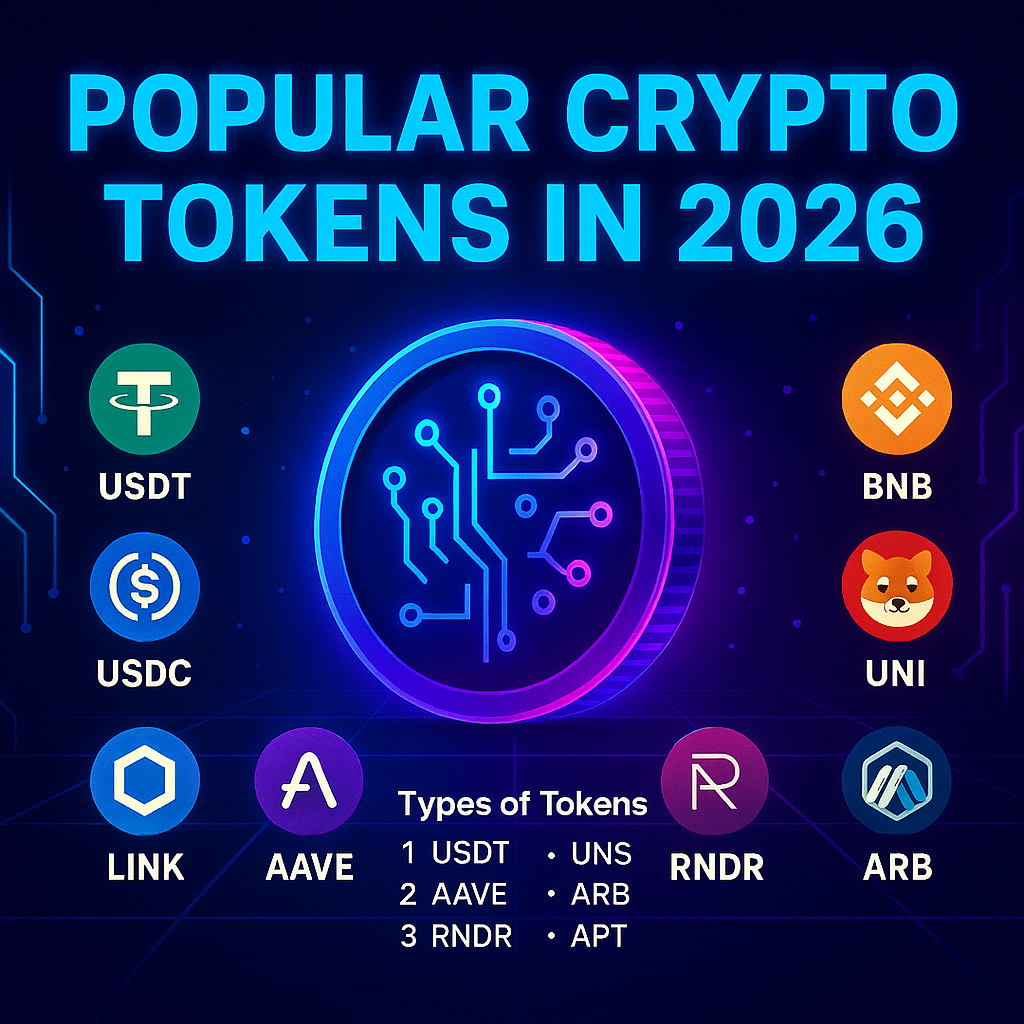
1. Tether (USDT)
Type: Stablecoin
USDT remains one of the most traded digital assets and is widely used as a trading pair across major exchanges.
2. USD Coin (USDC)
Type: Stablecoin
USDC is known for higher transparency and regular attestations, making it popular among institutions and DeFi users.
3. Binance Coin (BNB)
Type: Utility Token
BNB is used for trading fee discounts, staking, and powering applications within the BNB Chain ecosystem.
4. Uniswap (UNI)
Type: Governance Token
UNI allows holders to participate in the governance of one of the largest decentralized exchanges.
5. Chainlink (LINK)
Type: Utility Token
LINK powers decentralized oracle networks that connect smart contracts to real-world data.
6. Aave (AAVE)
Type: Governance Token
AAVE is the governance token of one of the leading decentralized lending protocols.
7. Render (RNDR)
Type: Utility Token
RNDR supports decentralized GPU rendering services used in AI, 3D, and digital content creation.
8. Arbitrum (ARB)
Type: Governance Token
ARB is the governance token of one of the most widely used Ethereum Layer 2 networks.
9. Aptos (APT)
Type: Utility Token
APT is the native token of the Aptos blockchain, designed for high throughput and scalability.
10. Shiba Inu (SHIB)
Type: Meme / Community Token
SHIB maintains a large community and continues to expand its ecosystem through additional products and Layer 2 development.
Pros & Cons of Investing in Tokens
Pros
- Wide range of use cases across DeFi, NFTs, and Web3
- Potential for high growth in successful projects
- Easy access on most major centralized and decentralized exchanges
- Ability to participate in governance and ecosystem growth
Cons
- High price volatility
- Risk of scams and low-quality projects
- Smart contract and technical vulnerabilities
- Strong dependence on the success of the underlying project
How to Evaluate a Token
Before investing in any token, consider the following factors:
- Background and credibility of the development team
- Clarity and quality of the whitepaper or documentation
- Tokenomics (supply, distribution, inflation, utility)
- Market data and trading volume on platforms like CoinMarketCap and CoinGecko
- Exchange listings and liquidity depth
- Community size and genuine engagement
- Real-world usage and adoption metrics
Traders who actively monitor markets may also combine fundamental research with technical and order-flow analysis. You can explore related tools and guides on the demo dashboard or review the user guide for multi-timeframe analysis features.
Tokens Often Considered for Longer-Term Exposure
While no token is risk-free, the following are frequently discussed for longer-term ecosystem exposure due to their utility and adoption:
- LINK – Critical infrastructure for decentralized oracles
- UNI – Governance of a major decentralized exchange
- AAVE – Leading decentralized lending protocol
- BNB – Core utility token within a large exchange ecosystem
- ARB – Governance token of a major Layer 2 network
- RNDR – Linked to growing demand for decentralized computing and AI-related workloads
Always conduct your own research and consider your risk tolerance before allocating capital.
Frequently Asked Questions
What is a crypto token?
A crypto token is a digital asset built on an existing blockchain that can represent utility, governance rights, stable value, or ownership of assets.
What is the difference between a token and a coin?
Coins operate on their own native blockchain (such as Bitcoin or Ethereum), while tokens are created on top of existing blockchains and are mainly used for applications, DeFi, governance, and utility.
What are the most popular tokens in 2026?
Some of the most widely used tokens include USDT, USDC, BNB, UNI, LINK, AAVE, RNDR, ARB, APT, and community-driven tokens such as SHIB.
Are tokens a good investment?
Tokens can offer significant opportunities but also carry high risks, including volatility, project failure, and smart contract issues. Proper research and risk management are essential.
How can I evaluate a token before buying?
Review the team, tokenomics, real utility, market liquidity, exchange listings, and community activity. Combining fundamental analysis with market structure tools can improve decision-making.
For traders interested in deeper market analysis, you may also find value in guides on order flow and imbalance strategies or explore available plans and tools.
Article prepared by the research team at 99ta100. This content is for educational purposes only and does not constitute financial advice.