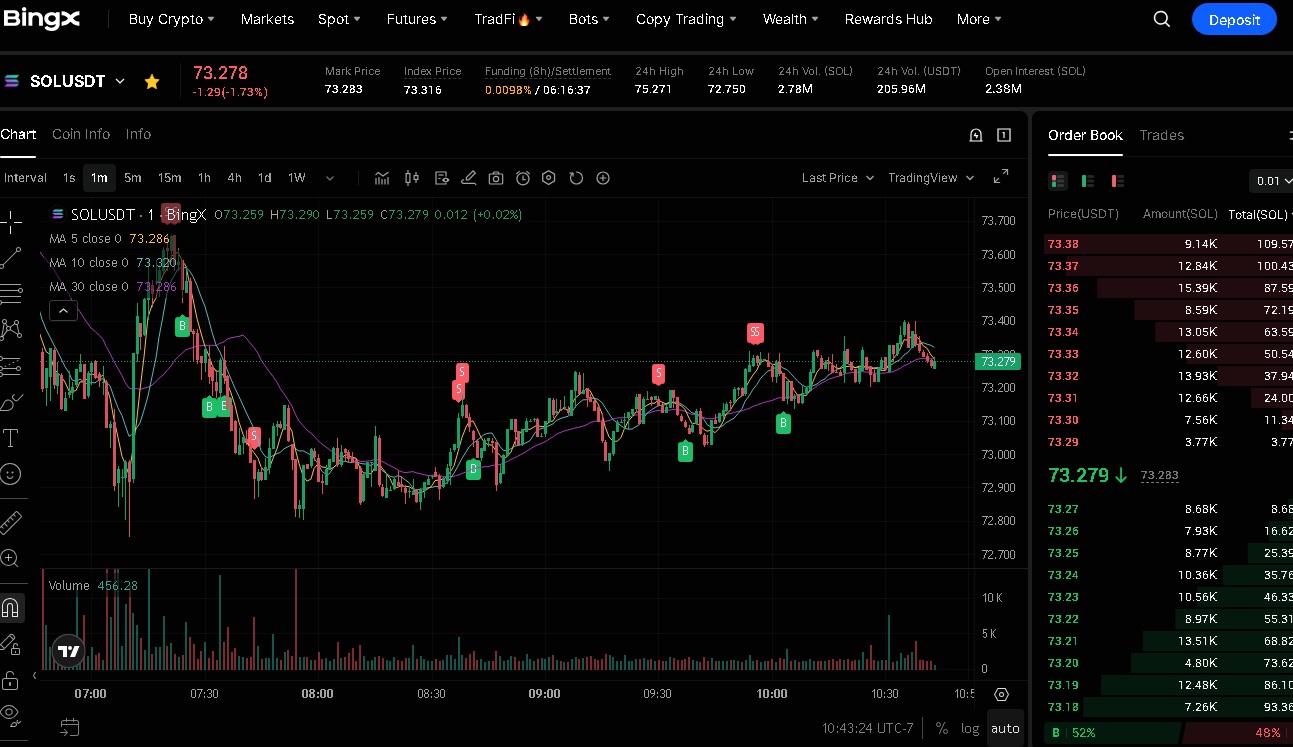
Real-Time Scalping Analysis on SOLUSDT (2026 BingX Market Breakdown)
The SOLUSDT chart on BingX provides a perfect example of real-time scalping opportunities in 2026. With Solana’s increasing volatility and deep liquidity, scalpers can exploit micro-movements using order flow and reaction timing. This guide breaks down the current SOLUSDT setup and explains how professional traders interpret it.
Solana (SOL) remains one of the most actively traded assets for short-term traders in 2026. Its high liquidity, frequent volatility spikes, and deep order books on platforms like BingX make SOLUSDT an ideal pair for scalping.
This article provides a practical, real-time style breakdown of how professional scalpers analyze SOLUSDT on BingX. You will learn how to identify liquidity zones, read order flow, set precise entries and exits, and manage risk on the 1-minute and 5-minute timeframes.
Why SOLUSDT Is Attractive for Scalping in 2026
Several factors make Solana particularly suitable for scalping:
- High trading volume and tight spreads on major exchanges including BingX
- Frequent micro-movements of 0.3%–1.2% within short periods
- Strong participation from both retail and algorithmic traders
- Clear liquidity clusters that often act as short-term magnets
Unlike longer-term swing trades, scalping focuses on capturing small, high-probability moves while keeping exposure time extremely short (usually under 5–15 minutes).
1. Market Structure Overview
When analyzing SOLUSDT for scalping, the first step is understanding the current short-term structure. On lower timeframes (1m–5m), price often moves between clearly defined liquidity pockets.
Typical behavior includes:
- Rapid moves into areas with stacked limit orders
- Temporary absorption of buy or sell pressure
- Quick rejection or continuation depending on volume
Professional scalpers do not predict the next big trend. They wait for price to reach a high-probability zone and then look for confirmation from order flow and candle behavior.
2. Identifying Key Scalping Zones
Effective scalping depends on recognizing three types of zones:
Liquidity Pocket Areas where a large number of limit orders are resting. These zones often cause temporary pauses or reversals because orders need to be filled before price can continue.
Pressure Zone Regions dominated by aggressive market orders (market buys or sells). These areas usually show strong directional momentum.
Reaction Zone Price levels that have previously produced multiple reactions (wicks, reversals, or strong volume spikes). These levels tend to remain relevant in the short term.
On BingX, you can observe these zones through the order book depth, volume profile, and real-time trade flow.
3. Reading Order Flow and Volume on BingX
Order flow is the most important edge for scalpers. Instead of relying only on indicators, focus on:
- Bid/Ask imbalance in the order book
- Speed of incoming market orders
- Volume spikes at specific price levels
- Funding rate and open interest changes (for futures)
A sudden increase in buy volume near a liquidity pocket, combined with absorption of sell orders, often signals a short-term bounce opportunity. Conversely, heavy selling into a support area without a meaningful reaction can indicate further downside.
4. Practical Scalping Strategy Framework
Here is a structured approach many experienced scalpers use on SOLUSDT:
Step 1 – Wait for price to reach a clear zone Do not chase price in the middle of a range. Let it come to a previously identified liquidity or reaction zone.
Step 2 – Look for confirmation Confirmation can include:
- Absorption of opposing orders
- Strong rejection wick
- Increase in volume in the direction of the intended trade
- Shift in order book imbalance
Step 3 – Define entry, stop-loss, and targets in advance Example structure (for illustration only):
- Entry near the edge of a liquidity zone
- Stop-loss placed beyond the opposite side of the zone (to avoid noise)
- First target at the next nearby liquidity cluster
- Second target if momentum continues
Step 4 – Manage the trade actively Scalping requires constant attention. Many traders move stop-loss to break-even once the first target is reached or scale out partially.
5. Risk Management Rules for SOLUSDT Scalping
Even the best analysis fails without proper risk control. Recommended guidelines:
- Risk only a small percentage of capital per trade (commonly 0.25%–0.5% for pure scalping)
- Avoid trading during major news events or extremely low-liquidity periods
- Keep maximum daily loss limits
- Do not average down on losing scalps
- Prefer high-liquidity sessions when spreads are tightest
Solana can experience sudden volatility spikes. Always use hard stop-losses and never risk more than you are comfortable losing.
6. How Advanced Tools Improve Scalping Decisions
Modern trading platforms and signal systems can help identify:
- Real-time liquidity zone mapping
- Order flow imbalances
- Speed bursts and absorption patterns
- Potential trap candles
Tools that combine exchange data feeds with structured analysis allow traders to react faster and filter low-quality setups. The goal is not to remove human judgment, but to reduce noise and highlight higher-probability moments.
Common Mistakes to Avoid
- Entering trades in the middle of nowhere without a clear zone
- Using wide stop-losses that turn a scalp into a swing trade
- Overtrading after a series of small wins or losses
- Ignoring the higher-timeframe bias completely
- Trading during thin liquidity hours
Final Thoughts
SOLUSDT remains one of the best pairs for scalping in 2026 due to its liquidity and volatility characteristics. Success does not come from predicting every move, but from consistently waiting for high-probability zones, reading order flow correctly, and applying strict risk management.
Focus on process over individual trade outcomes. Review your trades regularly, refine your zone identification skills, and stay disciplined with position sizing.
If you want to practice these concepts in a structured environment, you can explore the demo tools and analysis features available on the platform.